






For homeowners who are house rich but cash poor, a home equity agreement (also called home equity sharing or a home equity investment) can seem like a lifeline. It is often treated as a last resort, but it is not the only one.
This guide breaks down the most common alternatives, along with the pros and cons of each.
We'll assume more traditional options like HELOCs cash-out refinance, home equity loans and personal loans have already been ruled out, whether due to credit, income, or limited cash flow.
Understanding Home Equity Agreements (HEAs)
A home equity agreement is not a loan. Instead of borrowing money with monthly payments, you receive a lump sum of cash today in exchange for giving the company a share of your home's future value.
While every company structures its agreements differently, here's how they generally work:
- Length: Agreements typically last between 10 and 30 years.
- Share owed: The percentage you give up today doesn't translate 1-for-1 when you settle. You might receive cash equal to 10% of your home's current value, but when it's time to repay, you could end up owing 15%, 17%, even 20% of the home's future value — on top of sharing in the appreciation.
- Settlement: You typically settle when you sell, refinance, or reach the end of the term. If you can't pay at that point, selling the home may be the only option.
It's also worth noting that regulation is still catching up. In some states, HEAs are beginning to be treated more like mortgage products, but in others they remain lightly regulated. Compared with standardized products such as home equity loans or reverse mortgages, HEAs don't yet offer the same level of consumer protection or oversight.
A simple way to think about the cost: most agreements work out to the equivalent of borrowing at double-digit interest rates, sometimes 15–20% or higher for shorter-term agreements.
That's why HEAs are usually considered the least bad option for homeowners who can't qualify for traditional financing.
If you want to dig deeper:
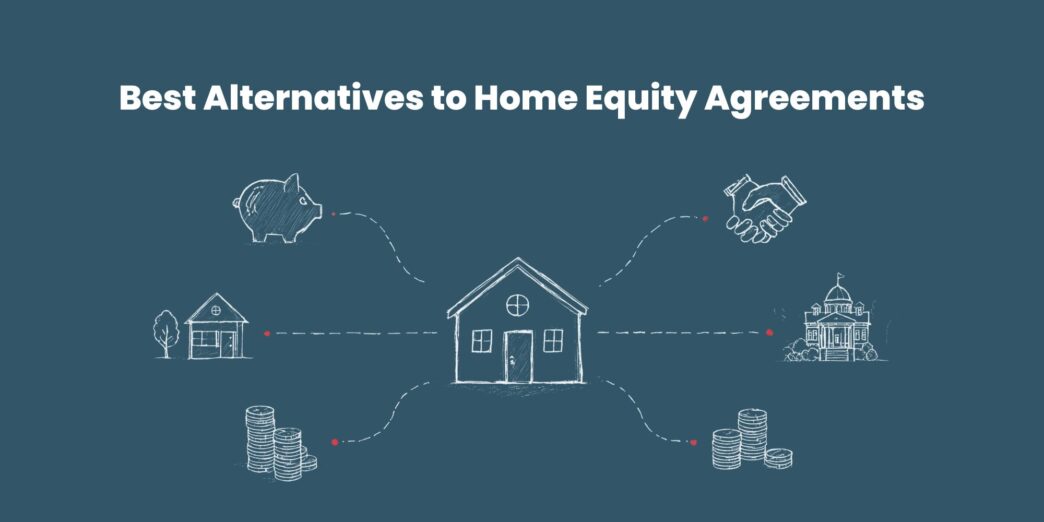
Ranking the Best Alternatives to Home Equity Agreements
The right choice depends on both eligibility and how much cash you need. These options fall into three categories, which we'll cover in detail below.
Best Alternatives for Large Cash Needs
Start with the most regulated lending options.
- Home equity loan, HELOC, or cash-out refinance. Predictable, fully regulated, clearer repayment.
- Downsizing (sell, buy smaller, or rent). Unlocks all your equity with no repayment obligations.
- Reverse mortgage (62+ or 55+ jumbo programs). No monthly payments, strong consumer protections if you qualify.
Best Alternatives for Smaller Cash Needs
These options preserve your home and avoid the high potential costs of equity-sharing, but may not be available.
- Roth contributions withdrawal. Tax- and penalty-free, but reduces future growth.
- 401(k) loan. Borrow from yourself, repay with interest. Works if job security is solid.
- Family loans (properly documented). Keeps wealth in the family, but requires formality to avoid tax issues.
Higher-Cost Options to Approach Carefully
These may solve an immediate problem but usually come with high long-term costs.
- Early retirement withdrawals (hardship, Rule of 55, SEPP/72(t)). Taxes, penalties, and lost compounding can apply.
- Home Equity Agreements (HEAs). No monthly payments, but potential for high effective annual costs.
- Hybrid equity loan (Unison) → Lower monthly payments now, appreciation share later.
Detailed Pros and Cons of the Best Home Equity Agreement Alternatives
Each option has trade-offs. Depending on your situation, some may offer more flexibility, lower long-term costs, or a better fit for your financial goals. Here's a closer look.
#1. Selling Your Home to Free Up Cash
What it is: Selling your current home and moving to a more affordable place, whether by buying something smaller, relocating to a lower-cost area, or choosing to rent.
Pros:
- Unlocks full access to your home equity
- No repayment obligations or long-term contracts
- Offers a chance to lower ongoing housing and maintenance costs
- Allows you to reset your financial plan on your terms
Cons:
- Emotionally difficult, especially if you've lived in your home for many years
- Requires a suitable and stable place to move
- Moving comes with costs and stress
- Long-term savings vary depending on where you go next
- May trigger capital gains taxes if appreciation exceeds IRS exclusion limits.
Could be an option if: You want to avoid any future obligations, whether that's debt or a home equity agreement. It may make the most sense if staying in your home would create long-term strain or if a home equity agreement would only delay an inevitable move.
Some tax considerations to consider here are:
- Exclusion of up to $250,000 (single) or $500,000 (married) if you've lived in the home two of the past five years. Gains above this are taxed at 15–20% federally, plus a possible 3.8% net investment income tax.
- State taxes may also apply
- Selling eliminates the “step-up in basis” heirs would otherwise receive.
R.J. Weiss, CFP® says: This is not an easy choice, and I don't take it likely bringing it up. But for many homeowners, downsizing is the most straightforward way to access equity and regain control. You get the funds you need without the long-term risks, and in many cases, you can reduce monthly expenses at the same time. Yes, it's hard. But it's worth taking an honest look, especially if your current path feels unsustainable.
#2. Reverse Mortgage
What it is: A reverse mortgage is a loan for homeowners age 62 and older that allows you to convert part of your home equity into cash. You don't make monthly payments. Instead, the loan is repaid when you move out, sell the home, or pass away. The most common type is a Home Equity Conversion Mortgage (HECM), which is federally insured and requires counseling before closing.
To learn more, see: Home Equity Agreement vs. Reverse Mortgages: What To Choose?
Pros:
- No monthly payments required as long as you stay in the home and meet conditions
- Federally regulated with built-in consumer protections (non-recourse, mandatory counseling)
- Flexible payout options: lump sum, monthly income, or a line of credit that grows over time — and you only pay interest on what you use
- Heirs are protected from owing more than the home's value when sold
Cons:
- Closing costs and mortgage insurance premiums can be high
- The loan balance grows over time, reducing your remaining equity
Could be an option if: You are 62 or older, want to stay in your home long-term, and need flexible access to cash without taking on new monthly payments. Reverse mortgages tend to be more predictable than HEAs, since costs are based on interest and insurance rather than a share of future appreciation.
R.J. Weiss, CFP® says: Reverse mortgages can be the right option for some homeowners, but quotes and terms vary widely, so it's important to compare multiple lenders. The required independent counseling is a real benefit here, as it helps ensure you understand the trade-offs before signing. If you qualify and plan to stay in your home long-term, a reverse mortgage can be a safer and more predictable choice.
#3. 401(k) Loan
What it is: A 401(k) loan lets you borrow from your retirement savings — usually up to 50% of your balance, capped at $50,000. You pay the loan back (with interest) over five years. Payments and interest go back into your account.
Pros:
- No credit check or outside lender needed
- Interest is paid back to yourself
- Quick access to funds if you're eligible
Cons:
- Limited to $50,000 (far less than most HEAs)
- Payments come from after-tax income, which is taxed again in retirement
- Missed payments or leaving your job can trigger quicker payoff
- Stops or reduces retirement contributions during repayment
- Not all employer plans permit loans
When it fits best: You need a modest sum, have stable employment, and want to avoid credit checks. It's best for short-term borrowing where repayment is realistic.
R.J. Weiss, CFP® says: Both options come with real costs. A 401(k) loan disrupts retirement growth but can be cheaper and safer for short-term borrowing. An HEA provides much more cash and no monthly payments, but the long-term cost can be higher if your home appreciates. In practice, I'd lean toward a 401(k) loan if the amount you need is modest and repayment is realistic.
#4. Early Retirement Withdrawals
What it is: Taking money from a retirement account before age 59½ usually triggers income taxes and a 10% penalty. Exceptions exist, such as hardship distributions (for specific, documented needs), the “Rule of 55” (no penalty if you separate from your employer at 55 or later), substantially equal periodic payments (SEPP/72(t)), and penalty-free withdrawals of Roth IRA contributions.
Pros:
- Immediate access to funds if you qualify
- Hardship distributions can help in true emergencies
- Roth contributions can be withdrawn tax- and penalty-free
- Rule of 55 or SEPP/72(t) can provide structured access for early retirees
Cons:
- Most withdrawals face taxes plus a 10% penalty
- Hardship withdrawals are tightly restricted and limited in amount
- Shrinks retirement savings and reduces future compounding power
When it fits best: You have a small, urgent need that can be met penalty-free (such as Roth contributions) or you're retiring early and have significant balances to work with.
R.J. Weiss, CFP® says: With an HEA, you keep your retirement savings intact but give up a share of your home's future value. With early withdrawals, you preserve your home but reduce the compounding power of your retirement accounts. For smaller gaps, withdrawing Roth IRA contributions can sometimes be the least harmful option. One exception is Aspire, which caps your payback at 12% if you exit within three years (credit score of 660 is required). That can be more affordable if you have a clear payoff plan. See our Aspire review.
#5. Unison's Equity Sharing Home Loan
What it is: A hybrid product that blends features of a home equity loan and a home equity agreement. You receive a lump sum upfront, make small interest-only payments during a 10-year term, and then repay the principal, deferred interest, and a share of your home's appreciation when the loan ends or you sell your home.
Pros:
- Lower monthly payments than a home equity loan, HELOC or cash-out refinance
- Preserves your first mortgage, which can be helpful if you locked in a low rate (compared to cash out-refinance)
- Flexibility to repay early without penalty
- You're making monthly interest payments, so you're not deferring all costs until the end
Cons:
- You must refinance or sell at the end of 10 years, which forces a quicker payoff than most HEAs
- Deferred interest compounds, increasing the final repayment
- Requires steady cash flow to cover monthly interest payments
- Strict eligibility requirements (e.g., 620+ credit score, ≤40% debt-to-income, 70–75% combined loan-to-value)
When it fits best: For homeowners with stronger credit and stable income who want cash but need to preserve a low-rate first mortgage. It's most suitable if you have a clear 5–10 year exit plan and can handle modest monthly payments in exchange for avoiding a large new mortgage.
R.J. Weiss, CFP® says: This product can be a better fit than an HEA if you have some cash flow and a defined timeline. You still give up a share of appreciation, but the costs are easier to predict. It's worth considering if you're disciplined and have a clear exit plan. See our Unison review for more details.
Other Alternatives With Limited or Niche Use Cases
The strategies above cover what most homeowners realistically consider. Still, there are a few additional paths that can work in narrower situations.
Rental income strategies
You may be able to create extra cash flow by renting out part of your property, such as a basement, an accessory dwelling unit (ADU), or even a room on a short-term basis. In some markets, the monthly income can be substantial and allows you to keep your home. The trade-off is that it requires upfront investment, landlord responsibilities, and possible local permitting hurdles. It can also take time and money to set up, and even longer before you begin to see income. This is not a solution for immediate cash needs, but it may help you stay in your home over the long term.
Family loans
If relatives have the means, a properly documented family loan can provide funds at reasonable terms while keeping wealth in the family. To avoid IRS issues, the loan must charge at least the Applicable Federal Rate and follow a written repayment schedule. While this can work well, it carries emotional risks if repayment becomes difficult.
Another option is an inter-family mortgage loan. Instead of borrowing from a bank, you borrow from your children or other relatives. They make payments to you over time, and in return they build ownership in the home. It can be a way to keep equity in the family rather than giving it back to a lender.
Property tax deferral programs
Some states and counties allow eligible homeowners, often seniors or those with limited income, to defer property taxes until the home is sold. This will not provide a lump sum like other options, but it can relieve ongoing cash-flow strain. Check with your local tax authority to see if you qualify.
Specialized financing
Certain households may have unique opportunities, such as a securities-backed line of credit if you hold a large taxable portfolio, or nonprofit/government grants for specific home repairs or energy upgrades. These options are rare in the HEA use case but can be worth exploring if your profile fits.
Final Thoughts on Choosing the Right Home Equity Agreement Alternative
When weighing a home equity agreement against its alternatives, four principles can guide you:
1. Prioritize predictability.
The clearer you understand the long-term cost of a choice, the easier it is to plan around it. Products with transparent repayment terms (like HELOCs or reverse mortgages) make it easier to forecast than HEAs, where costs are tied to uncertain future appreciation.
2. Weigh opportunity costs, not just penalties.
Tapping retirement accounts often feels like the “worst” option because of taxes and penalties.
But compare that to an HEA with an effective annualized cost of 15–20%. In some cases, paying taxes and penatlies today may be less damaging.
There's rarely a clear “right” or “wrong” — the trade-off is about which cost is more acceptable for your long-term plan.
3. Think long term.
These options can bring tremendous short-term relief, but you need to ask where the decision leaves you in five, 10, or 20 years. Will you still be in your home? How will you buy out the home equity agreement? Are your income and savings projections realistic? Avoid letting today's stress lead to a choice that undermines tomorrow's security.
4. Don't overlook taxes.
Whether it's losing the mortgage interest deduction, paying income tax and penalties on early withdrawals, or triggering capital gains by downsizing, taxes can change the math dramatically. Always factor them in before committing.
The bottom line: HEAs are sometimes the least bad option for homeowners in crisis, but they should never be used for discretionary spending and should always be compared carefully against safer, more predictable alternatives.